

How do you build a business case for a new ERP system?
Price both options. Most cases price only one.
The common failure: a careful, quantified cost of changing, set against an unstated assumption that staying still is free. It is not free, it is unbilled. The board declines, they say the reason is price, and the real reason is that the comparison was never made.
Download
11 sections with guidance prompts, financial tables, and an appendix of the questions to prepare for.
16 slides, speaker notes on every one, editable five year comparison chart.
Avanza Solutions is a MYOB Acumatica implementation partner based in New Zealand. These templates are published as neutral planning aids. They contain no product advocacy, they are designed to be useful whichever system you select, and they are equally usable if the case you build concludes that you should stay where you are.
Write it in this order
The case for change
If you cannot make this section compelling, nothing later will save it.
The financials
Because the numbers frequently change the argument. People discover the payback is faster than assumed, or slower, and either way it reshapes the ask.
Everything else
Options considered, benefits, approach, risks, governance.
The executive summary, last
It is the only page some readers will finish, and you cannot summarise an argument you have not yet made.
What boards and owners actually ask
01 What happens if we do not do this?
02 What is the payback, and when do we see cash back?
03 Who is accountable, and what else are they responsible for?
04 What is the worst case, and what does it cost us?
05 Where does the money come from, and what does this stop us doing instead?
06 How confident are you in these numbers, and which one worries you most?
07 Who else has done this, and did it work?
08 What does this take from the team, and who covers their day job?
09 Can we stop if it is going wrong, and what have we spent by then?
10 What did we spend on the current system, and why did that not solve it?
11 Why now rather than next year?
12 What would change your recommendation?
The last two catch people out most often.
"Why now" needs a real answer: a hardware refresh, a contract renewal, an audit finding, a growth event, someone about to leave. Boards defer anything that can be deferred, and a case with no timing pressure gets deferred by default.
"What would change your recommendation" is harder, and worth answering honestly. Be willing to say what set of facts would change your view. A recommendation that nothing could alter reads as advocacy rather than analysis, and boards can tell the difference.
What makes approval easier
Show where the project can be stopped
Name the phase gates, what is committed by each, and what is recoverable. Boards approve staged commitments far more readily than single large ones, and this slide often does more for the decision than the financial analysis.
Present the downside yourself
What happens if it costs twenty per cent more, runs three months late, or delivers half the expected benefit. Raising these yourself is what makes the base case believable. If you do not, someone else will, and it will look like you had not thought about it.
And two things that lose it
Understating internal effort. It will be discovered at the worst possible moment. A board that approves a project without understanding its internal cost will not defend it when month-end slips in week nine. State the days by role and phase, and say how they will be covered. "It will be absorbed" is not a plan and everyone in the room knows it.
No named owner. Cases without a named accountable person read as ideas rather than proposals. The first question about any proposal is who is doing this, and the second is what else they are responsible for.
Both, and they do different jobs
Send the written case in advance and present the deck. A board that has read the document asks better questions, and a deck that tries to be the document is unreadable in both formats.
Keep the presented body to twelve slides or fewer. End on the ask rather than on thank you, and then stop talking. The silence after a clear ask is uncomfortable, and it is where decisions get made.
Where the numbers come from
This is the point where the rest of the toolkit pays off. If you have completed those tools, most of the case is already written.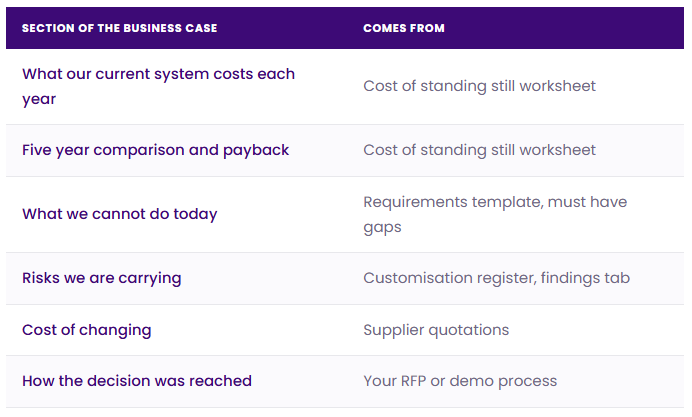
If you have not done that work, the templates still give you the structure. But a business case is only as good as the numbers behind it, and those tools are where the numbers come from.
Common Questions
Avanza Solutions is a MYOB Acumatica implementation partner based in New Zealand. These templates are published as neutral planning aids. They contain no product advocacy, they are designed to be useful whichever system you select, and they are equally usable if the case you build concludes that you should stay where you are.
Most often because only one option was priced. The board sees a large number with nothing to compare it to and declines on cost, even when the real problem is an incomplete comparison. The other common causes are understated internal effort, no named accountable owner, no answer to why now rather than next year, and benefits overstated to the point where everything else became doubtful.
An executive summary written last, a specific ask, the case for change, the options considered and why they were rejected, the recommended option and how the decision was reached, a five year financial analysis with payback and sensitivity, benefits and how they will be measured, the implementation approach including your own team's effort, risks and mitigations, and the phase gates at which the project could stop.
Compare the cumulative cost of standing still against the cumulative cost of changing across five years, and identify the year the difference turns in your favour. Include the cost of staff time in the standing still figure, because it is usually the largest component. For most mid-market organisations a payback comparison is more useful and more persuasive than a discounted appraisal, though your board may require both.
Both, and they do different jobs. Send the written case in advance so people arrive informed, then present a shorter deck. A deck that tries to be the document is unreadable as either, and a document delivered only as slides gives readers no way to check the detail.