

What should be in an ERP requirements document?
What your business needs to be able to do, in your own words, prioritised, with an owner against each line. Core functions, industry specifics, the platform and security requirements everyone forgets, and the things you need from the supplier rather than the software.
What it should not be is a feature list copied from a vendor's website. If your requirements happen to match one product's brochure, you have not written requirements. You have written a preference, and you ruled out better answers before you started.
It records what your current system already does
Most templates only ask what you want, which produces a wish list. Adding one column changes the exercise entirely.
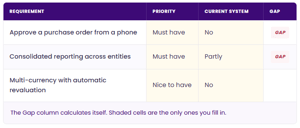
Requirements your current system already meets are not reasons to change, however important they are. The gaps are.
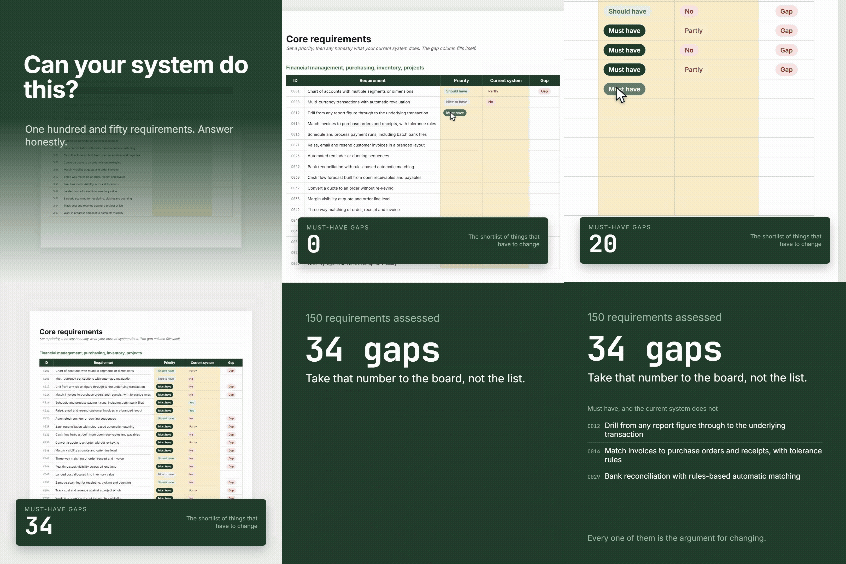
Someone who can say that thirty of their must haves are unmet today, and name them, has a business case. Someone with a list of two hundred wants has an opinion.
It also has a use nobody expects. Filling in that column reliably surfaces things people believed were impossible but were simply never configured or never demonstrated. Worth finding before you spend money replacing a system that could have done the job.
ERP Requirements Template
150 requirements already written and ready to edit, by function and by industry, with automatic gap analysis.
- Format - Excel (.xlsx)
- Core requirements - 100, across 14 functions
- Industry - 50, across 5 sectors
Five areas, and two everybody skips
The core
Financial management, payables, receivables, banking and cash, sales and orders, purchasing, inventory and warehouse, projects and job costing, reporting, workflow and approvals.
Your industry
Construction needs progress claims aligned to NZS 3910, retentions, variations, subcontractor management, cost to complete. Manufacturing needs bills of materials, routings, MRP, traceability. Wholesale needs landed costs, EDI, batch and expiry. Field services needs scheduling and mobile.
Skipped: users and security
Role-based permissions to field level, restricting access by entity or branch, multi-factor authentication, single sign-on, audit logging.
Skipped: platform and data
A documented public API, bulk import and export without vendor involvement, a sandbox separate from production, backup retention, recovery objectives, where your data physically lives, and how you get it out if you leave.
New Zealand compliance, and the supplier
GST and IRD filing, Payday filing, KiwiSaver, Holidays Act leave calculation, PAYE, multiple pay frequencies. State these explicitly rather than assuming, because it is genuinely where international products struggle. And include what you need from the supplier: local implementation team, support hours matching your working day, contractual response times, a named account manager, a published roadmap, the ability to defer an upgrade, and a documented data extraction process on exit. Asking for those in writing produces better answers than asking in a meeting.
The two amber sections rarely appear in a requirements list written by the finance team, and they are where the expensive surprises live.
ERP Requirements Template
150 requirements already written and ready to edit, by function and by industry, with automatic gap analysis.
Five rules for writing them so they actually work
Who actually uses this, and how often?
Ask the users, not the person who commissioned it. Anything answered with "never" or "I'm not sure" is a retirement candidate.
Do not specify how it should work
Requirements describing a solution rather than a need rule out approaches you have not considered. You are buying an outcome.
Keep must have scarce
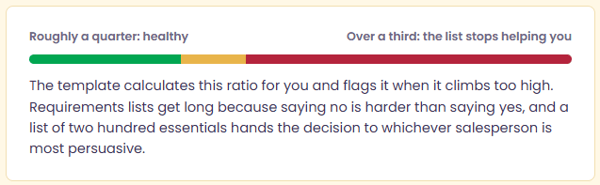
The discipline that makes everything else work. If most of your list is essential, you have given yourself no basis for choosing between options and no room to negotiate.
Give every requirement an owner
Someone has to judge whether a vendor's answer is good enough, and it should not always be you. It also means whoever insisted on a requirement is the person who defends it when the list gets cut.
Write it with the people who do the work
Requirements written by managers describe how a process is supposed to run. Requirements written with the people running it describe how it actually runs, including the workarounds nobody has mentioned.
Three things to do once they're written
Send it to every vendor before they present. Comparing suppliers is only possible when they answered the same questions, and one who ignores your document and delivers a standard demo has told you something useful about how the project would go.
Use the must have gaps as your demo agenda. Ask for those specific things to be shown, in your terms, rather than sitting through a presentation built around the vendor's strengths.
Revisit it after the demos. Requirements change once you have seen what is possible. That is the process working, not a planning failure.
Common Questions
Avanza Solutions is a MYOB Acumatica implementation partner based in New Zealand. This template is deliberately vendor neutral. It is not modelled on the capabilities of any one product, including the one we implement, and it is designed to be useful whichever system you choose.
The core functions your business needs, written as outcomes rather than features. Requirements specific to your industry. Platform and security requirements including API access, data extraction, backup and where data is held. New Zealand compliance requirements such as GST filing, Payday filing, KiwiSaver and Holidays Act leave calculation. And requirements of the supplier rather than the software. Every line should have a priority and an owner.
There is no correct number, but the ratio matters more than the total. If more than roughly a third are marked must have, the list will not help you choose between suppliers and will leave you no room to negotiate. Cutting the must have list is usually the most valuable hour spent on the whole document.
Be careful. A template produced by a supplier tends to reflect what that product does well, which quietly shapes the outcome before evaluation begins. Use a neutral starting list, then change the wording to match how your business actually talks, and add the things that matter to you that no template anticipated.
Yes, but mark them as met. They still belong in the document, because a new system must not go backwards. Recording that they are already met keeps them out of your case for changing, which should rest only on the gaps.

