

If you're running a construction business in New Zealand, you already know that accurate job costing isn't optional—it's the difference between a profitable project and one that quietly bleeds money whilst everyone thinks it's tracking fine.
Yet here's the surprising reality: only 40% of construction firms use specialised job cost accounting software.1 That means the majority are still cobbling together spreadsheets, manual processes, and educated guesses to track what's actually happening on their projects.
Meanwhile, companies that implement structured job costing methods improve their financial accuracy by 20-30%.2 That's not a marginal gain—that's the difference between consistently winning work at sustainable margins versus constantly wondering why you're so busy but not making the money you should be.
Let's look at the five job costing best practices that separate thriving construction firms from those just surviving, and how modern systems like MYOB Acumatica Construction Edition make these practices achievable for Kiwi contractors of all sizes.
Best Practice #1: Managing Scope Creep Before It Manages You
The Problem
Scope creep is the silent profit killer in construction projects. It creeps in through material shortages that require substitutions, regulatory changes that demand design modifications, unforeseen site conditions, and—most commonly—client requests for "small changes" that accumulate into significant cost impacts.
A commercial fit-out in Wellington starts with a clear brief. Then the client wants to shift some walls. Then they'd like upgraded fixtures. Then they need additional power points. Each change seems reasonable in isolation, but without proper tracking and approval processes, these variations can transform a profitable job into a marginal one.
The Solution
Managing scope creep starts with thorough client discussions during planning. What might change? What's the process for handling variations? Setting these expectations early creates a framework for managing changes professionally.
However, the real control comes from having a formal approval process for every change request. Each variation needs to be evaluated for its impact on design, resources, timeline, and—critically—cost before anyone commits to doing the work.
Transparent tracking is essential. Both you and your client need visibility into what's been requested, what's been approved, and how it affects the project timeline and budget. When variations are tracked properly, everyone understands the true scope of the project at any given moment.
How MYOB Acumatica Construction Edition Helps
MYOB Acumatica provides cloud-based job cost accounting with real-time visibility into budgets, contracts, and financials. When a variation request comes in, you can immediately see the impact on project costs and margins.
Automated workflows ensure that change orders move through proper approval channels before work commences. Your project managers can access variation history from their phones on site, and your commercial team can see exactly how approved changes affect project profitability.
The system creates an audit trail of every variation—who requested it, when it was approved, what it cost, and how it impacted the overall project. This transparency protects both you and your client, ensuring there are no surprises at final account.
Best Practice #2: Building Contingencies and Managing Risk
The Problem
Construction projects face countless variables. Personnel changes mid-project. Design flaws emerge during construction. Site conditions differ from what was expected. A subbie goes into liquidation. Materials are delayed or damaged in transit.
You can't predict every challenge, but you can plan for uncertainty. The firms that consistently deliver profitable projects are those that build realistic contingencies into their schedules and budgets, allowing flexibility for the inevitable rework and adjustments without blowing out costs or timelines.
Consider a civil contractor working on infrastructure in rural New Zealand who discovers unexpected ground conditions. Without contingency planning, this discovery triggers a cascade of problems—delayed equipment, idle workers, rushed decisions to get back on schedule. With proper contingency, the project manager has the time and budget flexibility to adapt properly.
The Solution
Effective risk management requires anticipating uncertainty from the outset. Job cost accountants and project managers must work together to identify potential risks and build appropriate contingencies into project plans.
Strong communication is fundamental. Regular, focused team discussions help identify problems early whilst they're still manageable. When everyone—from the site supervisor to the commercial manager—has visibility into project status, risks can be escalated and addressed before they become crises.
The key is having real-time information. If a problem emerges on site Tuesday morning, your project manager needs to see immediately how addressing it will impact project costs and timeline, not find out two weeks later when the reports are updated.
How MYOB Acumatica Construction Edition Helps
MYOB Acumatica tracks all project activities in one system—drawings, photos, change orders, RFIs, and all essential documentation. When something changes on site, it's captured immediately with automatic alerts to relevant team members.
Mobile access means your site supervisors and project managers can access project information, record issues, and update status from anywhere. They can link timesheets to specific cost codes, photograph site conditions, and document variations in real-time.
The system maintains a complete audit trail for compliance and dispute resolution. If a subcontractor claims they weren't notified of a change, you have timestamped documentation showing exactly what was communicated and when.
With proactive alerts—such as when costs are approaching budget thresholds or when documents require approval—your team can manage risks before they impact project profitability.
Best Practice #3: Accurate Budgeting Based on Real Data
The Problem
Before cloud-based construction accounting, budgeting often relied on a combination of experience, gut feel, and optimism. Estimators would recall what similar projects cost, add a bit for contingency, apply current rates, and hope for the best.
The problem? Human memory is selective. That comparable project from two years ago might have gone over budget in ways that weren't properly captured. Material costs have changed. Labour productivity varies between crews. Without accurate historical data, every estimate is essentially a guess.
When job costing isn't tracked properly throughout a project, you miss the opportunity to learn from both successes and failures. You can't identify which types of work consistently run over budget, which subbies are reliably profitable to work with, or where your team is most efficient.
The Solution
Mastering job cost accounting enables precise budgeting. By tracking actual costs across all projects—labour, materials, subcontractors, plant, and overhead—you build a reliable database of real performance that informs future estimates.
Efficient job cost management involves tracking accounts payable invoices, billing customers, and charging time to jobs in real-time, ensuring financial data remains current. This includes often-overlooked costs like time spent in meetings, preparing documentation, and managing subcontractors.
Keeping cost projections accurate throughout the project creates a feedback loop. You compare planned expenses with actual costs as the project progresses, identify where you're tracking well and where you're not, and apply these lessons to future estimates.
For a Quantity Surveyor pricing a new commercial project, having accurate historical data on similar buildings transforms estimating from guesswork into science. Instead of wondering what curtain wall installation costs per square metre, they can see exactly what it cost on the last three projects, adjusted for current rates.
How MYOB Acumatica Construction Edition Helps
MYOB Acumatica simplifies budgeting with real-time tracking and forecasting tools. You can monitor budgets, payroll, invoices, and billing for a clear cash flow overview across all active projects.
The system enables you to allocate overhead and shared expenses to individual projects accurately, ensuring your pricing reflects true costs. You can compare actual costs against both original and revised budgets using real-time reports, seeing immediately when a project is trending off track.
Budget forecasts can be adjusted as projects progress, and you can track financial performance across periods to identify trends. When your estimator is pricing new work, they can pull reports showing actual costs from completed projects with similar characteristics, making estimates based on real data rather than assumptions.
For commercial contractors managing multiple projects simultaneously, this visibility is transformative. You can see at a glance which projects are performing well, which need attention, and where to focus your team's efforts.
Best Practice #4: Accurate Time Tracking for True Project Costs
The Problem
Labour is typically the highest cost in construction, yet it's often the least accurately tracked. Site workers fill in timesheets at the end of the week, trying to remember which project they worked on and for how long. Salaried staff—project managers, engineers, administrators—often aren't allocated to projects at all, even though their time directly impacts project costs.
Subcontractor invoices arrive weeks after the work is done. Without proper tracking systems, these invoices can easily be misfiled, paid late, or allocated to the wrong cost codes. By the time you realise a project's labour costs are running over budget, you're already deep into the work with limited options to recover.
This lack of visibility makes it impossible to monitor budget status accurately, understand project burn rate, or identify unexpected resource drains until it's too late.
The Solution
Accurate time tracking is essential for payroll, invoicing, productivity measurement, and cost control. Knowing how much time is allocated to a project directly impacts profitability.
Modern construction firms capture time as close to the work as possible. Site supervisors approve timesheets daily or weekly, not monthly. Time is allocated to specific cost codes, enabling you to see not just total project labour costs but where that time is being spent—demolition, framing, services installation, finishing.
Salaried employees' time should also be tracked and allocated to projects. When your project manager spends 15 hours one week dealing with variations on a particular job, that cost needs to be visible in the project accounts.
For subcontractors, establishing clear invoicing requirements and approval workflows ensures their costs are captured and allocated correctly in real-time.
How MYOB Acumatica Construction Edition Helps
MYOB Acumatica streamlines timekeeping with cloud-based tools accessible from mobile devices. Site supervisors and workers can enter time from their phones, even on remote sites without internet coverage, with data syncing automatically when connectivity is restored.
The system handles employee time and expense tracking for both labour and materials. It manages certified payroll and union wage requirements—important for larger commercial and civil projects. Automated approval workflows ensure timesheets move from field supervisors to finance teams efficiently.
Timecards can automatically generate customer invoices for time and materials work and update contract status for lump sum projects. Real-time reporting enables you to monitor labour costs as they're incurred, not weeks later when the damage is done.
This visibility transforms project management. Instead of reacting to labour overruns after the fact, project managers can see trends developing and take corrective action whilst there's still time to protect project margins.
Best Practice #5: Efficient Project Closeout and Lessons Learned
The Problem
Project closeout is often rushed. Everyone's attention has moved to the next job, and the focus is on getting final payment and moving resources to new projects. This rush leads to missing paperwork, unaccounted expenses, inaccurate labour tracking, and lost opportunities to learn from the project.
Without proper closeout, you might miss billing for variations or additional work. Retention isn't tracked properly. Equipment and materials aren't released for reassignment. And most critically, the valuable lessons from the project—what went well, what didn't, why costs overran in certain areas—aren't captured for future reference.
The Solution
Effective project closeout requires systems and discipline. Establish processes to track approvals, emails, and documentation from the start of the project, not scrambling to find paperwork at the end.
Secure formal acceptance of the completed project from the client—in writing, with sign-off on all variations and final accounts. Update all project-related costs to ensure accurate financial reporting, including any late invoices or adjustments.
Release employees, contractors, equipment, and materials for future projects, ensuring your resource management system reflects their availability.
Finally, conduct a proper lessons-learned review. What went well? Where did costs overrun and why? How accurate was the original estimate? What would you do differently next time? These insights are gold for improving future project performance.
How MYOB Acumatica Construction Edition Helps
MYOB Acumatica simplifies project closeout with digital tools for tracking and managing all documentation in one place. Project documents, photos, email chains, RFIs, variations—everything is centrally stored and easily accessible.
The system integrates with DocuSign and Adobe Sign for digital approvals, making it easy to obtain formal client sign-off and close out documentation requirements efficiently.
Real-time tracking of labour and material costs means there are no surprises at closeout. All costs are captured and allocated throughout the project, not discovered weeks after practical completion.
Resources can be automatically released upon project completion, making them available for reassignment. The system integrates seamlessly with Accounts Payable and Purchase Orders, ensuring complete financial visibility and making it easy to verify that all suppliers and subbies have been paid.
For firms managing multiple projects, efficient closeout is crucial for maintaining cash flow and resource availability. MYOB Acumatica ensures this critical phase doesn't become a bottleneck.
The Integration That Makes It All Work
Here's what ties all five best practices together: they all require accurate, real-time information accessible to everyone who needs it.
Scope creep management needs real-time visibility into project budgets and margins. Risk management requires immediate alerts when problems arise. Accurate budgeting depends on comprehensive historical data. Time tracking must be simple enough that people actually do it. Project closeout needs all project information in one accessible place.
MYOB Acumatica Construction Edition seamlessly integrates with core financials—general ledger, accounts payable, accounts receivable, sales orders, purchase orders, inventory management, and CRM. This integration means information flows automatically between systems.
When a subcontractor invoice arrives, it's matched to the purchase order, allocated to the correct project and cost code, and immediately reflected in project costs. When a timesheet is approved, it updates both payroll and project labour costs simultaneously. When a variation is approved, it adjusts the project budget and creates the necessary documentation automatically.
This integration eliminates duplicate data entry, reduces errors, and ensures everyone is working from the same current information.
Making the Shift to Structured Job Costing
If your firm is among the 60% not using specialised job cost accounting software, you're not alone. But you are at a disadvantage.
The construction firms consistently winning profitable work in 2026 aren't necessarily the ones with the biggest teams or the longest trading history. They're the ones with accurate visibility into project costs, enabling them to price work competitively whilst maintaining healthy margins.
For NZ construction firms ready to move beyond spreadsheets and implement proper job costing, MYOB Acumatica Construction Edition provides the functionality needed to implement all five best practices we've discussed:
- Real-time visibility into project costs and profitability
- Automated workflows for variations and approvals
- Mobile access for site teams
- Comprehensive time and expense tracking
- Integrated financial management
- Complete audit trails for compliance and dispute resolution
The difference between estimating and knowing is the difference between hoping for profit and consistently achieving it.
Download Our Construction ERP Handbook
Want to understand more about how modern construction management systems work and whether your business is ready to implement structured job costing?
Download our Free Construction ERP Handbook for comprehensive guidance on: 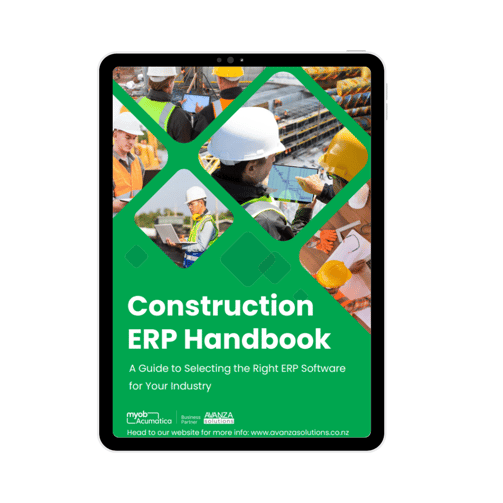
- Detailed functionality requirements for construction-specific ERP systems
- How to evaluate whether your current systems are holding back growth
- Questions to ask potential software vendors and implementation partners
- Implementation timeline and planning guidance specifically for construction firms
- Case studies from NZ construction companies who've made the transition
- ROI calculation frameworks for construction businesses
- How to prepare your team for system changes
The construction industry is becoming more competitive, margins are under pressure, and the firms thriving are those making decisions based on accurate data rather than guesswork. Isn't it time you joined them?
Avanza Solutions specialises in implementing MYOB Acumatica Construction Edition for commercial contractors, specialty trades, civil contractors, and construction materials suppliers throughout New Zealand. We combine deep construction industry knowledge with technical expertise to deliver solutions that genuinely solve business problems and drive profitable growth.
Our team understands the unique challenges of running construction businesses in New Zealand because we work exclusively in this sector. We know what works, what doesn't, and how to make the transition to modern construction management systems as smooth as possible for your team.
Sources:
1. Procore
2. Accountinginsights.org