
Mid-sized businesses across Australia and New Zealand are at an inflection point. According to MYOB's newly released Autonomous Business Report 2026, three quarters of decision-makers are planning to change or upgrade their ERP within the next two years — and the businesses that have already invested in modern systems, integrated data and AI strategy are pulling decisively ahead.
Surveying more than 1,000 leaders in mid-sized businesses across the Tasman, the report paints a clear picture: AI is no longer experimental. For many ANZ businesses, it is already embedded in core processes, freeing up hours every week and driving real commercial outcomes. But the gap between leaders and laggards is widening, and the foundations a business has in place will determine which side of that divide it ends up on.
Here are the headline findings, what they mean for New Zealand businesses, and where to start if you want to move from ambition to action.
What is business autonomy, and why does it matter?
Business autonomy goes beyond traditional automation. Where automation targets isolated tasks, autonomy connects data, systems and workflows so routine processes run end-to-end with minimal human effort — freeing your people to focus on judgement, relationships and strategy.
MYOB's Business Autonomy Maturity Model (BAMM) maps mid-sized businesses across two dimensions: readiness (the systems, data, governance and skills already in place) and ambition (the strategic intent to embed autonomy at scale). The result is four cohorts:
- Accelerating (43%) — high readiness, high ambition. AI is treated as a core capability and is already embedded in workflows.
- Operationalising (39%) — high readiness, lower ambition. Strong foundations, but progressing more carefully.
- Exploring (2%) — low readiness, high ambition. Eager to act but constrained by capability gaps.
- Reacting (16%) — low readiness, low ambition. AI use is isolated or absent.
The cohort a business sits in shapes the kinds of returns it sees from AI. Among Accelerating businesses, 92% report a positive productivity impact. Among Reacting businesses, that figure drops to just 37%.
The productivity dividend is real — and it is significant
For businesses with 50 to 99 employees, AI-assisted work is saving an average of four hours per employee per week. Scale that across a 75-person organisation and you are looking at 300 hours of capacity returned every single week — equivalent to nearly two extra full-time employees.
What businesses do with that capacity matters. The most advanced businesses are redirecting it toward higher-value work, and they are seeing the impact flow through to revenue, profitability and output quality. Lower-readiness businesses are still benefiting from time savings, but the gains tend to stay there rather than translating into commercial uplift.
This is the leader-laggard divide in action. Embedding AI in core processes — not just using it for individual tasks — is what unlocks meaningful, repeatable returns.
Why 75% of mid-sized businesses are upgrading their ERP
The report makes one thing very clear: ERP is the foundation for everything else.
Three quarters of the leaders surveyed plan to change or significantly upgrade their ERP within the next two years. That includes moves to a different cloud platform, transitions away from desktop or legacy systems, and consolidation onto integrated all-in-one cloud solutions.
The rationale is structural. Modern, cloud-based ERPs report stronger autonomy readiness, deeper AI integration and more significant productivity gains than legacy environments. Without a clean, integrated data foundation, AI tools cannot perform reliably and automation simply cannot scale.
For New Zealand businesses still running older or disconnected systems, this is the starting point.
"We need to start with an organised base and build from there. You can get so much more value out of AI and automation when it's all in the same place." — General Manager, Construction Business (interviewed for The Autonomous Business Report 2026)
The workforce gap that is quietly limiting returns
While 67% of businesses say AI is embedded in their core processes, structured training is only established in 57%. The infrastructure investment is happening, but the people-focused investment is not keeping pace — and that gap will quietly cap the returns a business can capture.
The data supports it. Nearly 90% of businesses with structured AI training report positive productivity impacts, compared to just 57% of those with informal or no training. Businesses that invest in technology without investing equally in capability will hit a ceiling well below their potential.
Reactive versus strategic: the marker of maturity
What triggers AI investment tells you a great deal about where a business is heading.
Lower-readiness businesses tend to invest in reaction to identified inefficiencies — a manual process that is breaking down, a cost target that needs to be met. Higher-readiness businesses are investing against a defined strategy, driven by leadership direction, scalability requirements and a deliberate intent to broaden where and how AI is applied.
Reactive investment fixes what is broken today. Strategic investment compounds. The businesses with a clear AI strategy, defined priorities, governance structures and a roadmap are the ones reporting the strongest returns.
Where New Zealand fits in the picture
ANZ businesses are not progressing at the same pace. Australian businesses tend to report stronger overall progress, with AI impacts extending beyond time saved into quality, revenue and profitability. New Zealand businesses show similarly strong ambition but are more often still in the earlier stages of their journey, with AI use concentrated on lower-order tasks and gains more often limited to time saved.
The good news? The foundations to close that gap are well understood. The five enablers identified in the report — data quality and integration, core systems and ERP, AI strategy and governance, workforce capability, and process automation — apply just as well in Auckland or Christchurch as they do in Sydney.
Five priorities for ANZ mid-sized businesses in 2026
Drawn directly from the report's recommendations, here is where to focus:
- Fix the data and systems foundation before scaling AI. A clean, integrated data environment is non-negotiable. Make ERP modernisation and data quality your highest-priority investments.
- Pair technology investment with workforce investment. Structured training is what turns AI access into AI returns.
- Replace reactive investment with a defined AI strategy. Clear priorities, governance structures and a roadmap will beat ad-hoc adoption every time.
- Embed AI into core processes, not just individual tasks. End-to-end workflows in finance, operations, supply chain and workforce management are where the commercial case is realised.
- Build governance before it becomes a constraint. Privacy, AI oversight and change management policies will protect your investments and clear the runway for scaling.
What this means for your business
For New Zealand mid-sized businesses, the message is encouraging. The market signal is clear, the foundations are well understood, and the productivity gains on offer are substantial. But the window for moving from ambition to action is finite — the gap between cohorts is widening, not narrowing.
If you are weighing up an ERP upgrade, refining your AI strategy, or trying to work out where to start, The Autonomous Business Report 2026 is a useful benchmark. It will give you a clear sense of where your business sits, what the highest-impact next steps look like, and how peers across ANZ are approaching the same challenges.
As an MYOB Acumatica implementation partner working with mid-sized businesses across New Zealand, our team at Avanza Solutions sees these patterns play out every day. If you want to talk through what an autonomous business roadmap could look like for your organisation, we would love to have that conversation.
Download the full report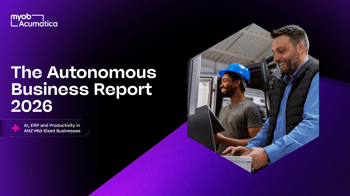
Get the complete Autonomous Business Report 2026 — including all charts, cohort breakdowns, industry analysis and the full set of recommendations.
Talk to our team about your ERP roadmap
Benchmark your AI readiness in 5 minutes
A free self-assessment for New Zealand business leaders, built on the MYOB Business Autonomy Maturity Model. Score yourself across five dimensions and see what to focus on next.
Frequently asked questions
What is business autonomy?
Business autonomy is the connection of data, systems and workflows so routine processes run end-to-end with minimal human effort, freeing employees to focus on higher-value work like judgement, strategy and customer relationships. Unlike traditional automation, which targets isolated tasks, autonomy is about integrated, end-to-end operations.
How many mid-sized ANZ businesses are upgrading their ERP?
According to MYOB's Autonomous Business Report 2026, 75% of decision-makers in mid-sized ANZ businesses plan to change or significantly upgrade their ERP within the next two years.
How much time does AI save per employee in mid-sized businesses?
Mid-sized businesses with 50–99 employees report saving an average of four hours per employee per week through AI-assisted work. Across a 75-person business, that equates to around 300 hours saved every week.
What is MYOB's Business Autonomy Maturity Model (BAMM)?
BAMM is a framework that maps mid-sized businesses across two dimensions — readiness and ambition — into four cohorts: Accelerating (43%), Operationalising (39%), Exploring (2%), and Reacting (16%). It helps businesses benchmark their position and identify their next priorities.
Why is ERP modernisation considered the foundation for AI?
Without a clean, integrated data environment, AI tools cannot perform reliably and automation cannot scale. Businesses with modern, cloud-based ERPs report stronger autonomy readiness, deeper AI integration and more significant productivity gains than those still on legacy systems.
Which industries are leading on business autonomy?
Professional services, financial services and construction consistently report the highest overall readiness, with strong and well-rounded capability across multiple pillars. Office-based businesses tend to lead on AI adoption for financial automation and data optimisation, while industrial businesses focus more on supply chain efficiency.